
- Details
- Category: News
By Matt Heller
All sell-outs are not created equal. Venue capacities vary, comp tickets may paper over gaps, and there are shifting definitions for what percentage even constitutes a “sold-out concert”. Still, musicians know a good house when we see one – and we love seeing them.
Recently, I heard about two Edmonton Symphony concerts that were programmed at the last minute, to replace a new opera project that unfortunately had to be withdrawn. The replacement concerts were led by the ESO’s string players, featuring Vivaldi’s Four Seasons and Shostakovich’s Chamber Symphony (arrangement of String Quartet no. 8 for string orchestra), and both were just about sold out. This led me to ask OCSM Delegates:
Question: Which concerts have sold out (or sold particularly well) so far this season?
Regina Symphony:
- Handel’s Messiah
- Love Notes (Regina Symphony Chamber Players); Two performances on Valentine’s Day, including selections by Tchaikovsky, Debussy, Ravel, Borodin, Mozetich, and Bizet
I have been asked to include that the RSO’s movie presentation of Home Alone and ABBA Pops were both ‘very close’ to selling out – ABBA breaking a 5-year attendance record. More generally, the RSO is reportedly on track to double ticket sales year over year – not sure when a Canadian orchestra last achieved that.
– RSO Delegate Simon Fryer
Symphony Nova Scotia
We don't have any technical sell-outs this season but here are some that came close:
- Mozart and Beethoven: 86% sold
- Natalie McMaster featuring Mary Frances Leahy: both nights approximately 90% sold
- Nutcracker: 87-91% sold over six performances
- Vivaldi Meets the Middle East: 95% sold out of 500 seats available (we really packed them in for that one and upped our capacity at St. Andrews Church)
- Magnificent Mozart: 91% sold
– SNS Delegate Rachel Desoer
Hamilton Philharmonic
- Valentine’s Day with Dwayne Gretzky
– HPO Delegate Jessie Brooks
National Ballet of Canada
- The Nutcracker, December 5 to 31, 2025 (33 performances)
– NBOC Delegate Maria Pelletier
Winnipeg Symphony
- Volodin Plays Tchaikovsky
- Harry Potter and the Deathly Hallows, part 2 (2 nights)
- International Cello Festival of Canada Grand Finale
- Symphony in the South (2 nights)
- How to Train Your Dragon (2 nights)
- Handel’s Messiah
- From the Inside Out (3 nights)
- Studio Ghibli
- Winnipeg New Music Festival Concerts 2 & 4
- Brawl at the Hall
- Murdock Mysteries
- Raiders of the Lost Ark (2 nights)
- James Bond Casino Royal
- Stewart Copeland
For our Classics concerts with a soloist, we do not open the second balcony. The orchestra has to be so far forward on the stage to be heard by the audience that anyone in the second balcony cannot see the soloist. So this reduces our capacity by 341. Had we been able to fill both balconies, two of those 21 concerts may not have been sold out.
Also, this season we have a number of concerts with smaller capacities to begin with. Examples: Desautels Concert Hall (Symphony in the South - 400), the MCCC Stage (for Inside Out), 201 Portage (WNMF2 - 80). Six sold out concerts fell in this category.
– WSO Delegate Alex Whitehead
Montreal Symphony
Concerts passés :
- Concert d’ouverture La damnation de Faust (Berlioz)
- Gratuit (aperçu de la saison) OSM360
- POP Salebarbes rencontre l’OSM
- Le chant du cygne de Mahler (Mahler 9)
- Jeux d’enfants Des bonbons ou un sort!
- Orgue Le fantôme de l’opéra
- Gratuit Finale du concours de l’OSM
- Ciné-concert 2001 : L’Odyssée de l’espace
- Una Voce avril La Symphonie « Pathétique » de Tchaïkovski
- De L’Europe au cinéma
- Le Messie : Alléluia!
- Le traditionnel conte des Fêtes de Fred Pellerin
- Orgue Stellaire : l’orgue fait son cirque
- POP Pérusse symphonique
- La musique de Harry Potter
- Les Noces de Figaro (version concert avec mise en scène partielle)
- Jeux d’enfants Le Carnaval de l’OSM
Concerts à venir (complets ou presque) :
- Le Requiem Allemand par Kent Nagano
- L’intense Symphonie « Leningrad » de Chostakovitch
- Le Sacre du printemps
- POP Hermanos Gutiérrez en concert
- Heroes : Symphonie de jeux vidéo
– OSM Delegate Stéphane Lévesque
Saskatoon Symphony
- Christmas Classics at the Cathedral
- Time for Toddlers series – 4 programs intended for 2-4 year olds
- Disney’s Beauty and the Beast in concert
- “Everything is Romantic” Valentine’s Day Concert, featuring Rachmaninoff Piano Concerto No. 2 with Angela Cheng
- Near sell-outs: Vivaldi’s Four Seasons, Handel’s Messiah
– SSO Delegate Lillian Jen-Payzant
- Details
- Category: News
By Matt Heller
Zack Reaves, a cellist and arranger based in Los Angeles, recently developed a new skill set: organizer. Musicians performing Candlelight shows were facing alarming changes in pay and working conditions. They had no collective representation or voice, until Zack stepped up. I interviewed Zack via email; he sent his responses on March 31, and the situation may have developed by the time you read this. 
Matt Heller: For all the cool ambience and marketing behind Candlelight, it seems musicians may be its real driving force. Can you tell us a bit about your work, and how Candlelight operates?
Zack Reaves: I’ve been involved with Candlelight since 2021, initially as an arranger crafting high-quality performance versions of songs for string quartet across nearly every genre imaginable. I then started performing concerts in Southern California in 2022. To date, I’ve written somewhere in the realm of 80 string quartet arrangements for the series, which have been performed by musicians worldwide, and I’ve personally performed in over 200 Candlelight shows. If you’ve played a Candlelight concert before, there’s a good chance you’ve played some of my arrangements! It has been one of the most exciting developments in my career having incredible musicians around the world perform my work and to do it in a way that is connecting with new audiences.
The way Candlelight operates varies a bit between city to city, and between different countries as well. In the US, performers primarily work through subcontracting agencies who streamline communication between the higher-ups at Fever (the company that produces Candlelight) and the musicians in each city. I get hired for both the performances and arranging through these subcontractors, who handle a huge amount of the organizational work. The musicians themselves are the ones determining the artistic quality of the performances: we organize our own rehearsals and make our own musical decisions just like a traditional chamber music ensemble, but all of the music is determined by Fever and the subcontractors.
Fever recently announced important changes to rehearsal pay and other working conditions. What would those changes have meant for Candlelight performers?
Over the past year, there have been a number of changes to how things were operating within the Candlelight concert series. The initial changes were minor, but eventually became more significant. The biggest issue, and what really spurred the organizing efforts among musicians, was a change in pay structure introduced in January of this year.
Previously, we had a pay rate and structure that had been in place for several years, accounting for different performance and rehearsal scenarios based on the personnel’s familiarity with a given program. New program launches came with two paid rehearsals, and substitute musician scenarios included a rehearsal at a lower rate, but when musicians all know the program well then no rehearsal is necessary. Performance fees also varied depending on if musicians were to perform the same program twice in one evening (lower rate), or two different programs (higher rate).
Fever’s motivation for changing this was understandable since rehearsal needs varied from concert to concert, the payment amounts were inconsistent, and substitute scenarios often came as a surprise charge. They wanted to simplify their books by introducing a flat rate fee for all performances, meaning that rehearsals and performances would all be lumped together moving forward. The problem, though, is that the proposed flat rate resulted in a significant pay cut for musicians across the US and Canada.
In addition to the pay structure, there were a number of other concerns that had been gradually building. First, many musicians had noticed a decline in the quality of arrangements being presented. In efforts to cut costs, arrangements were increasingly being outsourced to arrangers who were willing to do the work cheaply but whose output contained not only stylistic deficiencies, but also technical and notational errors. This created significant extra work for musicians on the ground, who were revising arrangements themselves in order to maintain the quality of their performances.
Another issue was program length. Concerts are supposed to run one hour, including musicians speaking from the stage to introduce themselves and the music, but new programs were regularly exceeding that time limit by a fairly significant amount.
There was also the matter of archival concert recordings. Fever had begun recording performances for internal review purposes — such as investigating a bad audience review or an unusual circumstance — and most musicians were generally fine with that. However, we were requesting an updated contract that clearly defined what those recordings could and could not be used for. Concerns included use for marketing purposes, commercial release, and most significantly, the potential for the recordings to be used for AI training and development. Our initial request for a revised contract was met with silence from Fever. Since going public with this information, the musicians now have Fever’s attention. The pay structure was returned to the previous rates, but many of the other issues remain unresolved.
Organizing a diverse group of musicians all over the continent is no small feat. How did you manage to do it?
The initial organizing efforts were a real whirlwind of meetings, emails, and phone calls over the course of several weeks. It all started with me making a post on Instagram highlighting the changes that Fever had made, and announcing that I was going to withhold any future arrangements for the series until these concerns were addressed. That post went viral very quickly, amassing over 6,500 likes and being viewed over 200,000 times within just a few days!
 Once that happened, musicians started reaching out to me on Instagram asking how they could get involved. Subcontractors also reached out, and I even received a phone call from Fever directly. I won’t pretend I wasn’t nervous when I made that initial post. I was genuinely concerned about losing work and potentially other forms of retaliation. But I had reached a point where I didn’t want my music to be used to continue growing a program that was, in my eyes, taking advantage of the very musicians who are its soul. The candles and the marketing may be a great draw to get people in the door, but the musicians are the reason audiences stay and the reason they come back.
Over the course of those few weeks, through all of those meetings and emails, I was able to connect with musicians in essentially every major market in the US and Canada. We now have around 50 representatives helping pass along the concerns of musicians in their communities, and relaying information back to them as well. It is important that everyone feels they have a voice in this.
What has the response to your work been like so far?
The response has been absolutely unbelievable, and it has been the single greatest motivating factor to keep the fight going. Not only did I hear from musicians across North America, but I’ve been hearing from musicians around the world who had also been frustrated by their experiences — and in almost every case, their situations were worse than what US and Canadian musicians were dealing with, especially regarding pay. Through all of this, I learned that musicians in the US and Canada were the only musicians in the world receiving rehearsal pay. Musicians in Europe, South America, Asia, and Australia have, to my knowledge, never received rehearsal pay and have always been on a flat rate that is lower than what we make here. I’m hopeful that exposing this information will also give musicians in other countries the courage to stand up and demand more fair treatment.
What has been most encouraging is that Fever has been communicating with me and with musicians more broadly on a semi-regular basis — really for the first time. They clearly don’t want the negative publicity around such a successful program, and they very quickly reverted back to our old pay rate and pay structure. We are hopeful that in the future we’ll be able to secure a cost-of-living wage increase for musicians everywhere, but for now, getting a $2 billion company to back down on its proposal is already a huge win.
They are also currently taking steps to address some of the additional concerns beyond compensation, though that is a longer play. I think Candlelight became so successful so quickly that Fever never really took a moment to stop and think about how to make it even better and more sustainable. This musician organizing effort has finally forced that moment of reflection, and I’m hopeful about where it leads.
What are some of the priorities for Candlelight musicians going forward?
I think the response we’ve received makes it pretty clear — Candlelight musicians genuinely want this to be successful over the long term. Not only has it been a steady source of work for musicians throughout the world, but it has also been a unique opportunity to bring chamber music to the broader public by way of non-classical genres like pop, rock, and hip hop (and classical programs too). And because of the unique intimate nature of chamber music, audiences are able to connect with us as individuals as well. We feel that we are truly a part of something special by building connections with audiences and demographics that classical musicians have struggled to reach for, well, basically forever.
So we want to make sure that our passion for this project is rewarded, not exploited. Hopefully we can improve working conditions enough to make this a genuinely viable long-term career path for the musicians who make it all possible.
Thank you for all of your work! Anything else you'd like to say to a bunch of Canadian orchestra musicians who are curious and maybe a bit jealous about the buzz that Candlelight has created?
It’s understandable to be skeptical — or perhaps even a little jealous — of the buzz that Candlelight has created. And we can all acknowledge that Fever has made mistakes in how it has implemented some of its strategies, particularly when it comes to taking care of its musicians and staff. But I also believe they have tapped into something special that we should all be paying attention to. It is quite remarkable what they’ve been able to accomplish with fairly simple advertising and, honestly, a fairly simple concept. They understood that by creating a unique aesthetic with tons of candles on a stage and making it social media friendly they could consistently fill concert halls.
My personal view is that while we should always respect the history and traditions of our art form, we should also be constantly looking for ways to make the concert experience feel relevant to the present moment and to the future. I’m hopeful that classical ensembles and organizations can learn from what Fever has done well, and make it authentic to their own musicians and institutional identity, while creating something that genuinely reflects what people are looking for in a concert experience in the 21st century.
Connecting with new audiences has been a passion of mine throughout my entire career, and it concerns me when musicians or organizations dig in their heels and insist on doing things the way they’ve always been done, in spite of obvious social and technological changes in the world. I also think times of uncertainty and turmoil are often when the best art and creativity emerge. When artists are met with a challenge, history shows us that we evolve time and time again. I suspect the digital age will ultimately be no different.
- Details
- Category: News
 Hello,
I am reaching out to advise you of important new permit requirements that may affect you if you are buying or selling products made of Pernambuco wood, also known as Brazil wood (Paubrasilia echinata) involving the movement of those products across international borders. Pernambuco wood is often used to make parts and accessories for musical string instruments, including high-quality bows.
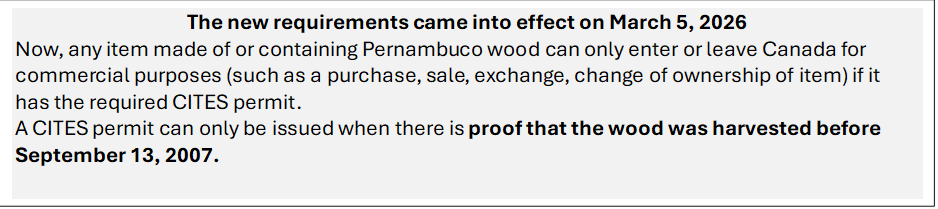
The new permit requirements came into effect on March 5, 2026.
Pernambuco wood comes from an endangered species of tree. The new rules, put in place under the Convention on International Trade in Endangered Species of Wild Fauna and Flora (CITES), will help monitor and control the trade of this wood to help reduce the risk of the species becoming extinct.
Key Changes
1. CITES Permits Now Required for All International Commercial Trade
- A CITES permit is required for all international commercial activity involving Pernambuco wood. This includes buying, selling, or exchanging items whether they are finished or unfinished.
- The previous exemption for re‑exporting finished musical instruments, accessories, and parts for commercial purposes no longer applies.
2. Prohibition on Commercial Trade in Wood Harvested After 2007
International commercial trade is now prohibited for Pernambuco wood which was taken from the wild (CITES source code W) on or after September 13, 2007. This is the date the species was first listed under CITES.
International trade is only allowed, via a permit, if:
- the wood was harvested before September 13, 2007 (this is called pre-convention), and
- the person applying for the permit can prove it
If you cannot prove the wood is pre-convention:
- a CITES permit cannot be issued
- the item cannot be traded internationally
- the item may only be traded within Canada

3. Non-Commercial Travel and Use: No Permit Needed
You do NOT need a CITES permit for the international travel or shipment of finished musical instruments, accessories and parts containing Pernambuco wood if:
- the movement is for one of the following non-commercial reasons:
-
-
- a performance (paid or unpaid)
- personal use
- display
- loan
- competition
- teaching
- appraisal
- repair
-
- AND when the item is outside of the owner’s usual country of residence:
-
-
- ownership of the item does not change
- the item is not sold, transferred or disposed of
-
This permit exemption allows musicians, organizations, and individuals to travel or ship items made of Pernambuco (such as bows) outside of the country without a permit, as long as the conditions above are met.
CITES Permits
- Importing into Canada: You must have a CITES export permit from the CITES authority of the country that the item is coming from.
- Re-exporting from Canada: You must have a CITES re-export certificate issued by the Canadian CITES authority.
You must have the required CITES permits before you import or export items. These permits must be checked (validated) by a border services officer at both the place of exit (for items leaving the country) and the place of entry (for items entering the country). Permits cannot be issued after the fact. If you do not have the correct permit, border officers can seize the item, and you will not be able to get a permit afterward to get the item back
For more information on Canadian CITES permits, including where and how to apply, please visit Permits for trade in protected species - Canada.ca.
Contact Us:
If you have any general questions about CITES or the new requirements, you may reach out to us at:
If you have specific questions about permits under the Convention on International Trade in Endangered Species of Wild Flora and Fauna (CITES), or would like assistance in completing CITES permit application forms, you may also contact the Canadian CITESmanagement authority:
- by email at
This email address is being protected from spambots. You need JavaScript enabled to view it. , or - by phone at 1-855-869-8670
Yours sincerely,
Caroline Ladanowski,
Director, Wildlife Management and Regulatory Affairs Division, Canadian Wildlife Service
Environment and Climate Change Canada | Government of Canada
351 St. Joseph Blvd., 13th Floor, Gatineau, QC K1A OH3
- Details
- Category: News
 This is OCSM’s first newsletter of the 2025-26 season, and it represents a bit of a shift. Moving forward, Una Voce will be a bit shorter (with three or four articles, rather than five or six) and more frequent, three or four issues a season.
We are also shifting to an online-only newsletter format. You will notice the opening of each article appears below, with a ‘read more’ link that will take you to the full article on OCSM’s website. We are no longer publishing a printable PDF format of the issue.
Why the shift? Mainly, to make Una Voce more timely and relevant. As editor, I want to spend less time creating PDFs and more time compiling interesting, useful content, then to get it translated and sent out sooner rather than later.
Speaking of which, you’ll find below:
- President Bob Fraser looks back on OCSM’s history, as we prepare for our 2026 Conference in Winnipeg (August 11-14).
- Settlement bulletins from around OCSM, compiled by our Delegates and hardworking negotiators. Improving standards and conditions is at the heart of what OCSM does.
- An infographic on tuning pitches, just in case you were curious. OCSM Delegates are frequently sharing all kinds of information, and I thought this was a fun example.
- Tamsin Lorraine Johnston writes about Screens vs. the Arts. Tamsin was OCSM’s 2nd VP until this past summer, and always has thought-provoking ideas and perspectives.
In fact, Tamsin’s article got me thinking about timely replies, in this world of snowballing digital communications. That could be the subject for a manners and etiquette column, which is not really what I want to write. I do think it can raise all sorts of interesting questions, however.
- Details
- Category: News
 At any given time, as many as half of OCSM orchestras are negotiating collective agreements. That process can take a full year, or longer. So our negotiating teams, usually staffed by musician volunteers and Local officers, deserve our gratitude and appreciation.
Over the past several months, settlement bulletins have been published for newly ratified agreements by the Victoria Symphony, Winnipeg Symphony, Calgary Philharmonic, National Ballet of Canada Orchestra, Regina Symphony, Quebec Symphony, and Vancouver Symphony. A settlement bulletin is also forthcoming for an agreement ratified by the Canadian Opera Company.
Some highlights:
- Most new agreements included modest wage increases, often between 3-4% annually. No orchestras agreed to salary decreases.
- Many orchestras addressed health and sick leave policies, in the aftermath of the pandemic. Victoria Symphony clarified that sick leave may be used for care of a sick family member.
- Tenure procedures were an area of focus for the Calgary Philharmonic, OSQ, Canadian Opera Company, and National Ballet, which noted that changes were based on model procedures from the AFM Symphonic Services Division (SSD).
- Both OSQ and the Calgary Phil updated their dress codes to provide more options and remove outdated requirements.
Settlement bulletins allow us to share these and other highlights, though they can only provide a brief summary of the changes and their rationales. If you have questions, you are encouraged to ask a peer orchestra’s Delegate or a member of their Negotiation Committee. SSD staff can be a great resource in researching best practices for CBA language.
Please visit the Symphonic Services Division’s Resource Centre to view the Settlement Bulletins. You will need to log in as an AFM member to access the site.
Thanks to all the Negotiating Committees for their hard work, and to the Delegates and Negotiating Committee members for assisting in compiling these bulletins.
By Matt Heller, OCSM Secretary
- Details
- Category: News
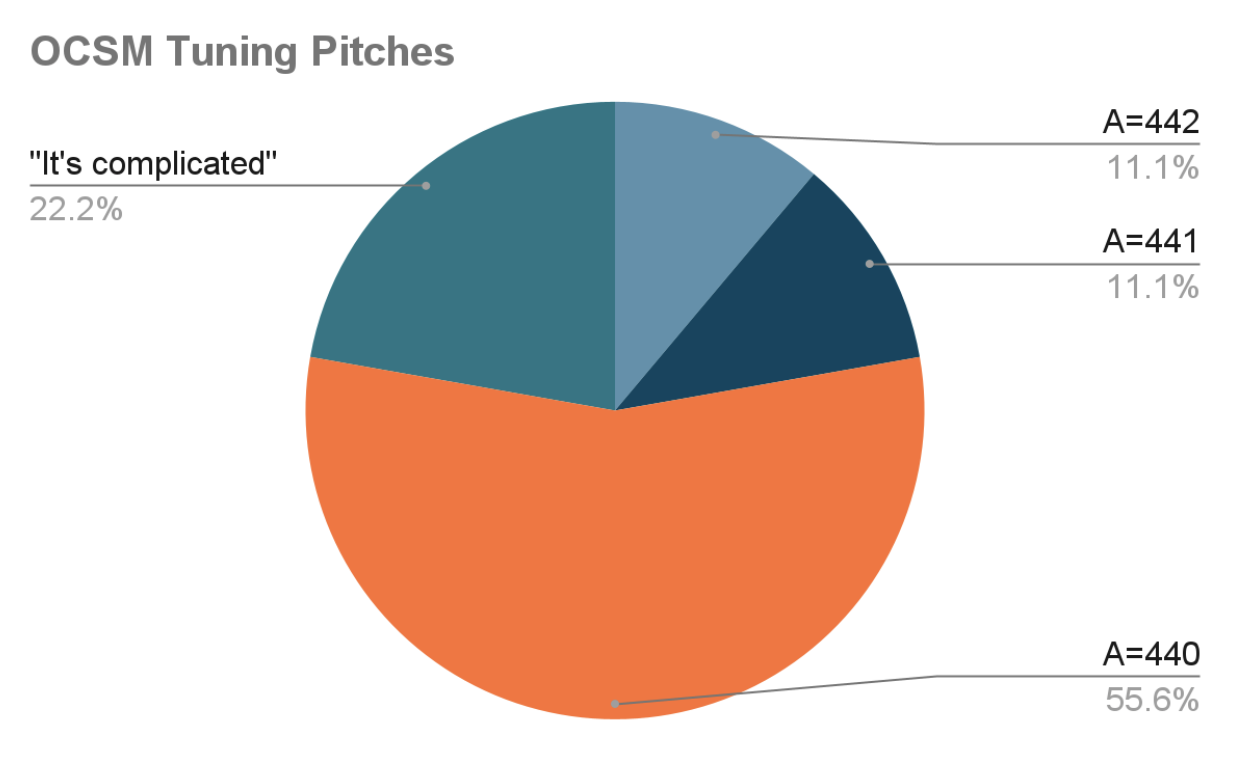
On a daily basis, OCSM Delegates share information about practices, standards, and issues affecting their orchestras. We are starting a monthly feature, “Ask an OCSM Delegate”, highlighting some of the intel they gather.
Question: Can you let me know what tuning pitch your orchestra takes (440, 441, et cetera)?
- Alex Conway, Winnipeg Symphony
- Details
- Category: News
 The performing arts have a crucial role in contemporary society as an inoculation against the encroachment of screens and apps into every part of our lives. Like books and other reading materials, live performances of music and dance inspire storytelling. Entering the performing arts venue, navigating a variety of social exchanges, and ultimately seating oneself in the space for a presentation that many will share unites the dual purposes of fulfilling a personal experience with collective participation.
Today’s world is a digital world. Nearly everyone carries a smart phone; a powerful computer on our person at all times, with laptops and tablets that talk to our smart phones never far from reach. At home, additional devices connect to our phones to organize our lives— thermostats, fridges, doorbells, lights. Ordinary appliances have become “smart”, claiming to make our lives simpler and allow us more time for us.
Theoretically, outsourcing routine tasks to technology should reveal a cleared path to creativity and self-actualization, with stops for self-care and quality time with loved ones along the way. In reality, even as we have banished boredom and loneliness, seeking to optimize every feature of life, our minds have never been busier.
- Details
- Category: News
 This summer will be fifty years since the first OCSM Conference, and the formation of its first Executive Board. That day-long event was held at the Hotel Triumph in Toronto on August 15, 1976. I can’t find much online about this hotel, which no longer exists, except that it had a disco attached to it called the “Canary Cottage” (I’m sure there’s a story to be told there).
OCSM was the third of the AFM Player Conferences to be established. The first was the International Conference of Symphony and Opera Musicians (ICSOM), in 1962. Then the Recording Musicians Association followed, in 1969. By then, the Toronto Symphony were ICSOM members (hence ICSOM’s “International” name), but OCSM founders Ruth Budd and Sam Levine both felt that our unique orchestral scene in Canada needed a Canadian group. The beginnings of OCSM were day-long symposia held as part of the Canadian Conference of the AFM – the annual meeting of Local Officers from all the Canadian AFM Locals (which we now sometimes refer to as the CFM). Although these were successful, it was felt that a musician-driven meeting, held at a time when most of the orchestras were on summer hiatus, would be the way to go.
Many of you reading this weren’t born in 1976. I was ten years old, and it was around then that I had “first contact” with the professional orchestra nearest me, the Winnipeg Symphony Orchestra. Communications in 1976 were either on paper that had to be mailed, or telephone calls (conference calls did exist, but they were exceptionally rare and expensive, as was regular long-distance calling). It’s hard to imagine this world now, even though widespread use of the Internet only really goes back 30 years or less.
- Details
- Category: News
 This summer’s OCSM Conference meets August 9-12 at the Hyatt Regency in downtown
Toronto.
- Details
- Category: News
 From Una Voce, June 2025, Issues in Focus: Audience Engagement; Social media in Vancouver and a podcast in Calgary.
- Vancouver Symphony: Growing reach, with a personal touch
- From the President
- Coming Full Circle in Unity: a highly subjective and personal memoir
- In memoriam: Douglas “Pace” Sturdevant
- Photo gallery: What we did last summer
- 2024 OCSM Conference Report
- Saskatoon Symphony Low Brass: Decades of Camaraderie
- Conductor Evaluations: Your Opinion Matters!
- Orchestral freelancers need a Bill of Rights. Australia might show us a way.
- Orchestra Librarians | Les musicothécaires d'orchestre