
By Matt Heller
Zack Reaves, a cellist and arranger based in Los Angeles, recently developed a new skill set: organizer. Musicians performing Candlelight shows were facing alarming changes in pay and working conditions. They had no collective representation or voice, until Zack stepped up. I interviewed Zack via email; he sent his responses on March 31, and the situation may have developed by the time you read this. 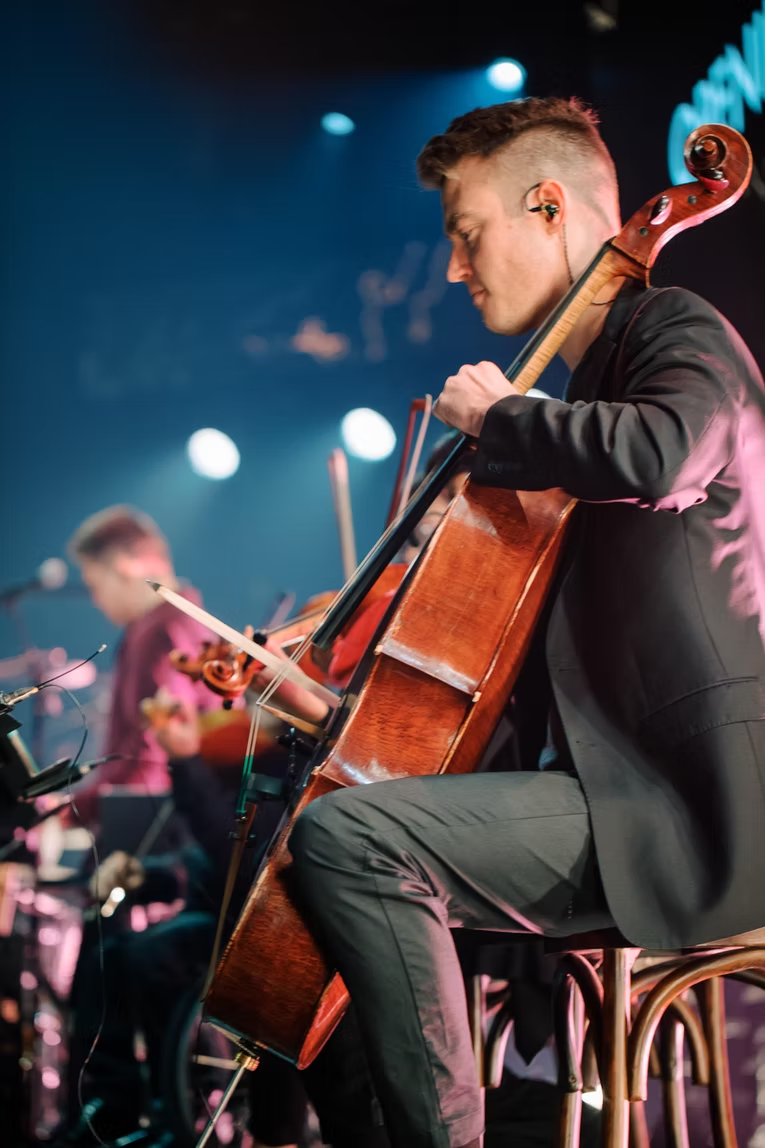
Matt Heller: For all the cool ambience and marketing behind Candlelight, it seems musicians may be its real driving force. Can you tell us a bit about your work, and how Candlelight operates?
Zack Reaves: I’ve been involved with Candlelight since 2021, initially as an arranger crafting high-quality performance versions of songs for string quartet across nearly every genre imaginable. I then started performing concerts in Southern California in 2022. To date, I’ve written somewhere in the realm of 80 string quartet arrangements for the series, which have been performed by musicians worldwide, and I’ve personally performed in over 200 Candlelight shows. If you’ve played a Candlelight concert before, there’s a good chance you’ve played some of my arrangements! It has been one of the most exciting developments in my career having incredible musicians around the world perform my work and to do it in a way that is connecting with new audiences.
The way Candlelight operates varies a bit between city to city, and between different countries as well. In the US, performers primarily work through subcontracting agencies who streamline communication between the higher-ups at Fever (the company that produces Candlelight) and the musicians in each city. I get hired for both the performances and arranging through these subcontractors, who handle a huge amount of the organizational work. The musicians themselves are the ones determining the artistic quality of the performances: we organize our own rehearsals and make our own musical decisions just like a traditional chamber music ensemble, but all of the music is determined by Fever and the subcontractors.
Fever recently announced important changes to rehearsal pay and other working conditions. What would those changes have meant for Candlelight performers?
Over the past year, there have been a number of changes to how things were operating within the Candlelight concert series. The initial changes were minor, but eventually became more significant. The biggest issue, and what really spurred the organizing efforts among musicians, was a change in pay structure introduced in January of this year.
Previously, we had a pay rate and structure that had been in place for several years, accounting for different performance and rehearsal scenarios based on the personnel’s familiarity with a given program. New program launches came with two paid rehearsals, and substitute musician scenarios included a rehearsal at a lower rate, but when musicians all know the program well then no rehearsal is necessary. Performance fees also varied depending on if musicians were to perform the same program twice in one evening (lower rate), or two different programs (higher rate).
Fever’s motivation for changing this was understandable since rehearsal needs varied from concert to concert, the payment amounts were inconsistent, and substitute scenarios often came as a surprise charge. They wanted to simplify their books by introducing a flat rate fee for all performances, meaning that rehearsals and performances would all be lumped together moving forward. The problem, though, is that the proposed flat rate resulted in a significant pay cut for musicians across the US and Canada.
In addition to the pay structure, there were a number of other concerns that had been gradually building. First, many musicians had noticed a decline in the quality of arrangements being presented. In efforts to cut costs, arrangements were increasingly being outsourced to arrangers who were willing to do the work cheaply but whose output contained not only stylistic deficiencies, but also technical and notational errors. This created significant extra work for musicians on the ground, who were revising arrangements themselves in order to maintain the quality of their performances.
Another issue was program length. Concerts are supposed to run one hour, including musicians speaking from the stage to introduce themselves and the music, but new programs were regularly exceeding that time limit by a fairly significant amount.
There was also the matter of archival concert recordings. Fever had begun recording performances for internal review purposes — such as investigating a bad audience review or an unusual circumstance — and most musicians were generally fine with that. However, we were requesting an updated contract that clearly defined what those recordings could and could not be used for. Concerns included use for marketing purposes, commercial release, and most significantly, the potential for the recordings to be used for AI training and development. Our initial request for a revised contract was met with silence from Fever. Since going public with this information, the musicians now have Fever’s attention. The pay structure was returned to the previous rates, but many of the other issues remain unresolved.
Organizing a diverse group of musicians all over the continent is no small feat. How did you manage to do it?
The initial organizing efforts were a real whirlwind of meetings, emails, and phone calls over the course of several weeks. It all started with me making a post on Instagram highlighting the changes that Fever had made, and announcing that I was going to withhold any future arrangements for the series until these concerns were addressed. That post went viral very quickly, amassing over 6,500 likes and being viewed over 200,000 times within just a few days!
 Once that happened, musicians started reaching out to me on Instagram asking how they could get involved. Subcontractors also reached out, and I even received a phone call from Fever directly. I won’t pretend I wasn’t nervous when I made that initial post. I was genuinely concerned about losing work and potentially other forms of retaliation. But I had reached a point where I didn’t want my music to be used to continue growing a program that was, in my eyes, taking advantage of the very musicians who are its soul. The candles and the marketing may be a great draw to get people in the door, but the musicians are the reason audiences stay and the reason they come back.
Over the course of those few weeks, through all of those meetings and emails, I was able to connect with musicians in essentially every major market in the US and Canada. We now have around 50 representatives helping pass along the concerns of musicians in their communities, and relaying information back to them as well. It is important that everyone feels they have a voice in this.
What has the response to your work been like so far?
The response has been absolutely unbelievable, and it has been the single greatest motivating factor to keep the fight going. Not only did I hear from musicians across North America, but I’ve been hearing from musicians around the world who had also been frustrated by their experiences — and in almost every case, their situations were worse than what US and Canadian musicians were dealing with, especially regarding pay. Through all of this, I learned that musicians in the US and Canada were the only musicians in the world receiving rehearsal pay. Musicians in Europe, South America, Asia, and Australia have, to my knowledge, never received rehearsal pay and have always been on a flat rate that is lower than what we make here. I’m hopeful that exposing this information will also give musicians in other countries the courage to stand up and demand more fair treatment.
What has been most encouraging is that Fever has been communicating with me and with musicians more broadly on a semi-regular basis — really for the first time. They clearly don’t want the negative publicity around such a successful program, and they very quickly reverted back to our old pay rate and pay structure. We are hopeful that in the future we’ll be able to secure a cost-of-living wage increase for musicians everywhere, but for now, getting a $2 billion company to back down on its proposal is already a huge win.
They are also currently taking steps to address some of the additional concerns beyond compensation, though that is a longer play. I think Candlelight became so successful so quickly that Fever never really took a moment to stop and think about how to make it even better and more sustainable. This musician organizing effort has finally forced that moment of reflection, and I’m hopeful about where it leads.
What are some of the priorities for Candlelight musicians going forward?
I think the response we’ve received makes it pretty clear — Candlelight musicians genuinely want this to be successful over the long term. Not only has it been a steady source of work for musicians throughout the world, but it has also been a unique opportunity to bring chamber music to the broader public by way of non-classical genres like pop, rock, and hip hop (and classical programs too). And because of the unique intimate nature of chamber music, audiences are able to connect with us as individuals as well. We feel that we are truly a part of something special by building connections with audiences and demographics that classical musicians have struggled to reach for, well, basically forever.
So we want to make sure that our passion for this project is rewarded, not exploited. Hopefully we can improve working conditions enough to make this a genuinely viable long-term career path for the musicians who make it all possible.
Thank you for all of your work! Anything else you'd like to say to a bunch of Canadian orchestra musicians who are curious and maybe a bit jealous about the buzz that Candlelight has created?
It’s understandable to be skeptical — or perhaps even a little jealous — of the buzz that Candlelight has created. And we can all acknowledge that Fever has made mistakes in how it has implemented some of its strategies, particularly when it comes to taking care of its musicians and staff. But I also believe they have tapped into something special that we should all be paying attention to. It is quite remarkable what they’ve been able to accomplish with fairly simple advertising and, honestly, a fairly simple concept. They understood that by creating a unique aesthetic with tons of candles on a stage and making it social media friendly they could consistently fill concert halls.
My personal view is that while we should always respect the history and traditions of our art form, we should also be constantly looking for ways to make the concert experience feel relevant to the present moment and to the future. I’m hopeful that classical ensembles and organizations can learn from what Fever has done well, and make it authentic to their own musicians and institutional identity, while creating something that genuinely reflects what people are looking for in a concert experience in the 21st century.
Connecting with new audiences has been a passion of mine throughout my entire career, and it concerns me when musicians or organizations dig in their heels and insist on doing things the way they’ve always been done, in spite of obvious social and technological changes in the world. I also think times of uncertainty and turmoil are often when the best art and creativity emerge. When artists are met with a challenge, history shows us that we evolve time and time again. I suspect the digital age will ultimately be no different.